How to Actually Improve a Process
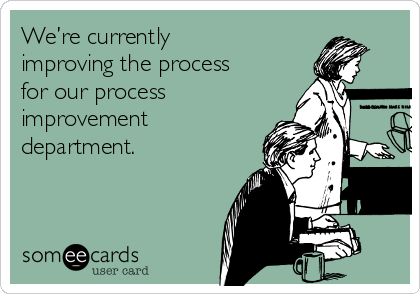
Most teams focus on running existing processes well and not improving the process itself. The process is a product in itself and deserves to be treated that way.
It is easy to fall into this trap. Everyone is focused on the output: did we ship, did we hit the deadline, did the thing get done? Nobody is focused on the process itself: where did it break down, what would make it cleaner next time, is it even worth improving? Those questions never get asked because it's nobody's job to ask them.
The result is processes that get run the same way for years. Problems get tolerated because they've always been there. Inefficiencies harden into norms. You hear “if it ain’t broke, don’t fix it,” which is simply code for settling for mediocrity. And when something finally breaks badly enough to demand attention, the team does a complete overhaul instead of the small steady improvements that could have prevented it.
Two things fix this: an improvement loop and an owner (or as some like to call it, “a single wringable neck”).
The Improvement Loop
Step 1: Pick an Owner
Assign one person to own the process. Not the team as whole or “leadership”. Pick an actual person and ensure they set aside the time for this work.
The job is not to facilitate the process (although maybe they are doing that too), it is to document the process ahead of time, take notes during the process, lead the analysis afterwards, and own any follow ups for next time.
Step 2: Document the Process
You don’t need a detailed document (although it might help if the process is complex), just a clear description of the steps, who owns each one, and when they need to occur.
Writing it down forces a useful conversation, especially as teams grow and processes that were tribal knowledge now need to be taught more broadly. The first time you try to document how something actually works, you'll usually discover obvious issues and single points of failure that are being glossed over.
You don’t need to do this ahead of time, you can do this as part of the notetaking in Step 4 as well which may be useful for long running processes.
Step 3. Define Success
This is the part that is most often skipped. This is not success of the output of the process but success of the process itself.
Be specific. Stay away from "the sprint went well" but instead use "we shipped before the deadline, the proper communication channels were used, and no work was blocked for more than 24 hours."
There is often a strategic or cultural angle to this success. Do you want to be the type of team that forces overtime? Does your company strategy rely on being world class in a given process?
Step 4: Run the Process and Take Notes
The owner is responsible for keeping a running log as the process happens. Be detailed and note each step. There is no need to judge or analyze yet, just gather the information so it can be used later.
Step 5: Analyze and Improve
At the end of the cycle, the owner brings the log to a short evaluation. Even if the process went perfectly it is worth spending a short 30 minutes discussing the following three questions:
Did we hit the success criteria? (if “yes”: should the success criteria change?)
What was the single biggest problem?
What is one thing that could improve the process next time?
If the process went particularly awry then a full post mortem may be needed.
Make any improvements, update the documentation and success criteria, and run the loop again.
What the Owner Actually Does
The process owner is not a project manager tracking tasks. They have one responsibility: make this process better over time.
In practice that means keeping the documentation accurate, observing the process while it runs, facilitating the evaluation, driving the changes that come out of it, and checking whether previous changes actually worked.
It's not a full-time job for most processes. A few hours per cycle. But it has to be an explicit responsibility. If it becomes a shared responsibility, it means no one is responsible.
Give the owner real authority to make changes as long as they discuss them with stakeholders. If every improvement needs leadership approval, the loop stalls. Small iterative changes should be up to the owner.
Final Thoughts
Operating a team well is a combination of gathering the right talent, giving them the right roles, and running the right playbook. So much effort is spent on finding the right talent who can run the plays in the playbook and not enough on the playbook itself.
A key indicator that someone is senior level talent is that they are not only a great player in their role but also a student of the game. I look for people that can not only run a process, but can also own improving it over time.
I will always strive to build teams that have a culture of improvement and look to constantly outdo themselves.